The world of b2b marketing automation is on the brink of dramatic transformation as we approach 2025. Companies that want to stay ahead must understand the trends reshaping how businesses engage, nurture, and convert leads.
This post reveals seven critical b2b marketing automation trends that will define strategy, technology, and ROI in the coming year. Expect bold predictions, data-backed insights, and actionable guidance to help future-proof your marketing approach.
Explore how AI-driven personalization, omnichannel experiences, real-time triggers, and privacy-first workflows are setting new standards. Get ready to unlock next-level growth and give your business a true competitive edge.
The State of B2B Marketing Automation in 2025
The world of b2b marketing automation is in the midst of a transformation. In 2025, platforms are smarter, more integrated, and more attuned to the demands of modern buyers than ever before. Let’s break down how these key shifts are setting the stage for a new era of automated B2B marketing.

Evolution of B2B Automation Platforms
B2b marketing automation has come a long way from its early days of simple email blasts. Today’s leading platforms, including HubSpot, Salesforce, and Marketo, offer unified ecosystems where email, social, chat, and events are orchestrated seamlessly. The integration of AI and workflow automation is now standard, accelerating everything from lead qualification to nurture streams.
A recent State of B2B Marketing Automation 2025 Report reveals that over 70% of B2B marketers plan to increase their automation investments in 2025. This surge is fueled by the rise of AI SDRs, which are transforming sales development, and the shift toward human-in-the-loop automation, ensuring quality remains high.
Here’s a snapshot of recent platform evolution:
| Era | Core Feature | Example Platforms |
|---|---|---|
| Email-centric | Batch email campaigns | Early HubSpot, Eloqua |
| Multi-channel | Cross-platform integration | Salesforce, Marketo |
| AI-powered | Real-time, predictive AI | HubSpot AI, Marketo AI |
As technology matures, b2b marketing automation is becoming the backbone of modern B2B engagement.
Current Challenges and Opportunities
Despite rapid progress, b2b marketing automation still faces persistent challenges. Data silos make it tough to build unified customer profiles. Many teams struggle with lack of personalization, which dampens engagement and conversion rates. Attribution remains complex as buyers move across channels, and compliance pressures add another layer of difficulty.
Yet, these obstacles create room for innovation. Enhanced lead scoring models, real-time engagement tactics, and improved ROI measurement are unlocking new value. Industry benchmarks show automation adoption rates climbing, with top-performing campaigns leveraging integrated data and advanced analytics.
Key opportunities include:
- Streamlining data flows for unified insights
- Leveraging AI for smarter segmentation
- Automating compliance and consent management
Organizations that address these pain points stand to gain a competitive edge in the b2b marketing automation landscape.
Why 2025 Is a Pivotal Year
2025 marks a turning point for b2b marketing automation. Generative AI is reshaping how marketers create and deliver content. Privacy regulations are tightening, pushing companies to adopt privacy-first automation strategies. Buyer expectations are rising, with demand for relevance and value at every touchpoint.
There’s a clear shift toward quality over quantity in both outbound and inbound campaigns. Disruptors and new entrants are challenging established vendors, driving innovation across the board. As a result, teams that adapt quickly will find themselves leading the market, while those who lag may struggle to keep pace.
In summary, b2b marketing automation in 2025 is defined by rapid advancement, strategic challenges, and unprecedented opportunity.
7 B2B Marketing Automation Trends To Watch In 2025
The future of b2b marketing automation is unfolding at a record pace. In 2025, the intersection of AI, data, privacy, and human expertise will set new benchmarks for lead engagement, conversion, and ROI. Whether you are optimizing existing workflows or exploring new automation platforms, understanding these seven trends is essential to stay ahead.

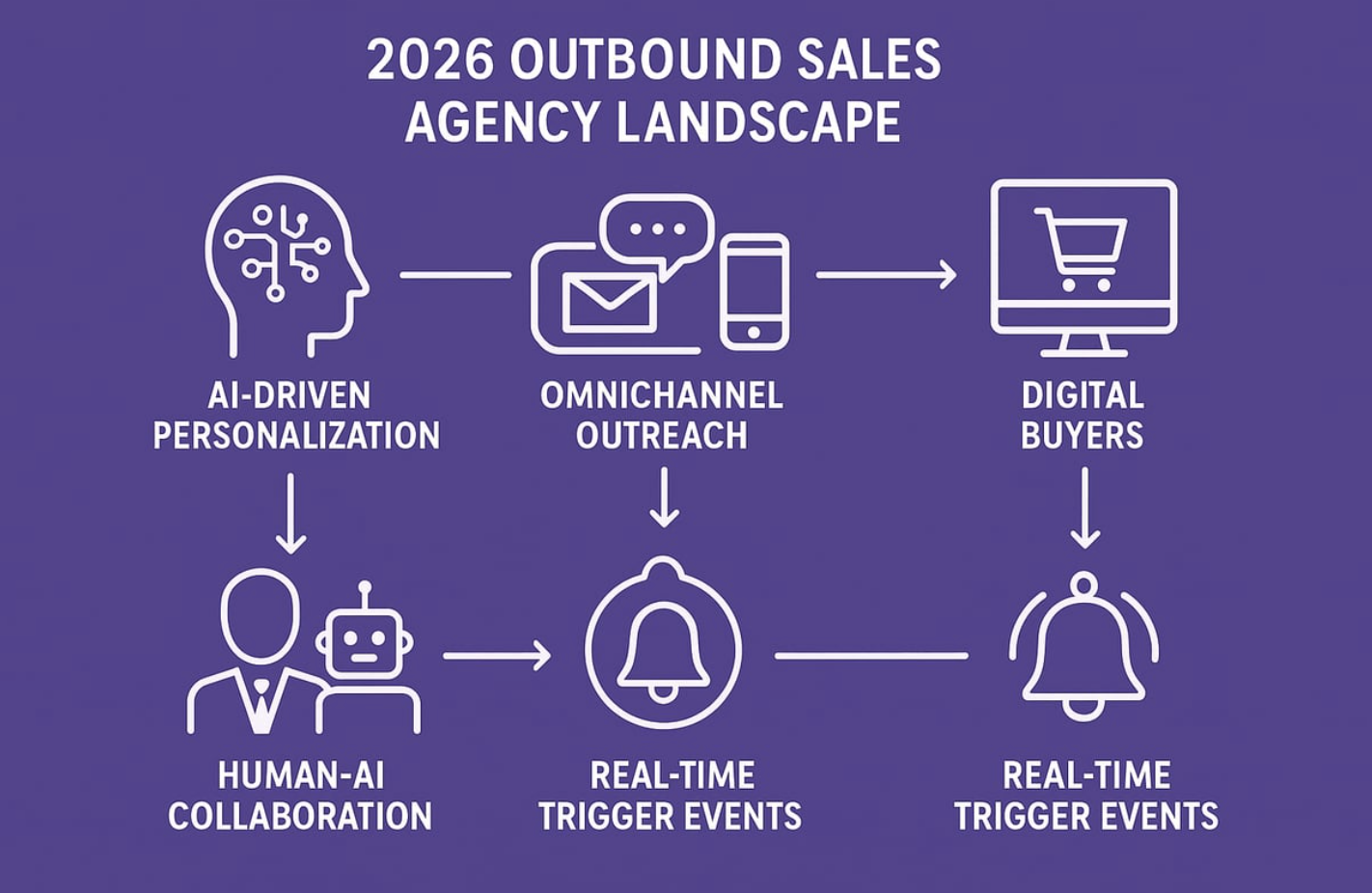
1. AI-Driven Personalization at Scale
B2b marketing automation is moving beyond basic audience segmentation. In 2025, AI-driven personalization will dominate, enabling companies to deliver hyper-relevant content, offers, and experiences at every touchpoint.
Machine learning models now analyze buyer intent, behavioral signals, and firmographics in real time. This allows marketers to tailor messaging, website content, and product recommendations for each individual or account. For example, predictive email sequencing adapts content based on recipient engagement, while dynamic landing pages adjust based on industry or buying stage.
A recent study shows that companies leveraging advanced personalization in b2b marketing automation achieve up to 20 percent higher conversion rates. Platforms like HubSpot and Marketo are embedding AI-powered engines that curate content for each visitor, optimizing both inbound and outbound journeys.
Yet, challenges remain. Data quality is paramount, as AI models are only as good as the information they process. Transparency is another concern, with marketers needing to understand and trust the logic behind automated decisions. Balancing automation with human oversight ensures messaging remains authentic.
Looking ahead, zero-party and first-party data will become the backbone of personalization. With stricter privacy laws, marketers must collect data directly from prospects and customers, using consented information to power AI models. For a deeper dive into how businesses are scaling tailored outreach, see this guide on personalizing outreach at scale.
2. Omnichannel Orchestration & Cross-Platform Automation
Gone are the days of siloed campaigns. B2b marketing automation in 2025 is all about orchestrating seamless, unified experiences across every channel, from email and LinkedIn to SMS, chat, and live events.
Modern tools now integrate CRM, social platforms, and event management systems, creating a single view of each prospect and enabling consistent messaging. Salesforce’s Customer 360 is a prime example, offering a comprehensive engagement layer that brings together all touchpoints. This orchestration ensures prospects receive the right message at the right time, regardless of where they are in the funnel.
A recent benchmark reveals that 65 percent of B2B buyers interact with brands on four or more channels before making a decision. Orchestration not only boosts engagement rates but also improves attribution, helping marketers understand what works and where to allocate resources.
However, this approach introduces challenges. Data synchronization across platforms is complex, and attributing success to specific channels can be tricky. Teams must also allocate resources efficiently to avoid spreading themselves too thin.
In summary, omnichannel orchestration is no longer optional. B2b marketing automation must meet rising buyer expectations for integrated, consumer-grade experiences across every touchpoint.
3. Trigger-Based Prospecting & Real-Time Outreach
Trigger-based prospecting is redefining how b2b marketing automation identifies and engages leads. Rather than relying on static lists, automation systems now monitor real-world events—such as funding rounds, leadership changes, or media appearances—to surface high-potential prospects in real time.
Platforms like Samplead use AI to detect these triggers, flagging opportunities for immediate outreach. For example, a company might initiate a LinkedIn campaign after a prospect is mentioned in a podcast or secures new funding. This timely engagement increases relevance and response rates, with industry data showing that trigger-based campaigns deliver up to three times higher engagement than traditional approaches.
The benefits are clear: sales cycles shorten, pipeline value rises, and marketing teams focus on leads that are most likely to convert. Use cases range from automated follow-ups after event attendance to real-time alerts for website visits from target accounts.
Challenges include identifying which triggers truly matter, integrating diverse data sources, and maintaining personalization at scale. As b2b marketing automation evolves, the ability to act on meaningful signals will separate leaders from laggards.
4. Privacy-First Automation & Compliance-Driven Workflows
Data privacy is now central to b2b marketing automation strategy. With GDPR, CCPA, and new global regulations, marketers must build automation workflows that prioritize consent, transparency, and data minimization.
Leading platforms like Marketo and Salesforce have rolled out robust privacy compliance features, including consent management tools and audience segmentation based on data usage rights. In 2025, 80 percent of B2B marketers cite privacy as their top concern, reflecting the shift from quantity to quality in lead management.
To build trust, marketers should communicate clearly about data usage, offer easy opt-in processes, and regularly audit their automation workflows. Privacy-first automation is not just about compliance—it is a differentiator that can enhance brand reputation and customer loyalty.
However, balancing personalization with privacy remains a challenge. As laws evolve, marketers must adapt quickly, ensuring every automated touchpoint meets regulatory standards. Auditability and documentation are now required capabilities in modern b2b marketing automation stacks.
5. Human-in-the-Loop Automation for Quality Engagement
While AI-powered SDRs are growing in sophistication, human oversight is more valued than ever in b2b marketing automation. Human-in-the-loop platforms blend the efficiency of automation with the nuance and judgment of sales professionals.
Samplead’s approach is illustrative: AI detects triggers and drafts initial outreach, but humans review, approve, and personalize messages before they go out. This hybrid model reduces errors, ensures message relevance, and fosters deeper prospect relationships.
Statistics back this up. Outreach sequences reviewed by humans receive 30 percent more positive responses than those sent fully automated. Use cases include approval workflows, personalized edits, and collaborative campaigns where marketing and sales share responsibility.
Scaling human oversight can be challenging, especially for large teams or high-volume campaigns. Training, workflow integration, and change management are crucial. Ultimately, b2b marketing automation will be defined by platforms that empower—not replace—human creativity and expertise.
6. Predictive Analytics & Next-Best-Action Recommendations
B2b marketing automation is shifting from retrospective reporting to predictive and prescriptive analytics. AI now powers recommendations for the optimal content, timing, and channel for each lead, dramatically improving conversion rates.
Platforms like Salesforce Einstein use predictive lead scoring and next-best-action modules to guide marketers and sales teams. By analyzing historical engagement, firmographics, and intent data, these systems suggest what to do next for each prospect.
Predictive analytics users report a twofold improvement in lead-to-customer conversion rates. This data-driven approach enables smarter resource allocation and closed-loop attribution, empowering teams to focus on what truly moves the needle.
Challenges include integrating disparate data sources, ensuring model accuracy, and driving user adoption. The future lies in combining predictive and generative AI, allowing b2b marketing automation to optimize campaigns in real time and scale winning strategies.
7. Automation for Account-Based Marketing (ABM) & Hyper-Segmentation
Account-based marketing is rapidly evolving, with b2b marketing automation playing a pivotal role in delivering highly targeted, multi-touch campaigns. Automation tools now support account-level insights, intent data analysis, and personalized outreach sequences for each target company.
Platforms like Demandbase and HubSpot are leading the way, offering ABM modules that integrate seamlessly with CRM and marketing workflows. Marketers can automate gifting, create personalized landing pages, and build account-specific nurture streams, all from a single platform.
The impact is substantial: 87 percent of B2B marketers report higher ROI from ABM than from other initiatives. Benefits include increased deal sizes, improved targeting accuracy, and stronger alignment between sales and marketing teams.
However, success depends on data accuracy, the ability to create relevant content at scale, and effective cross-team collaboration. As b2b marketing automation matures, ABM and hyper-segmentation will remain cornerstones of high-performing strategies.
Integrating Emerging Trends Into Your 2025 B2B Marketing Strategy
Staying ahead in b2b marketing automation means more than adopting the latest tools. It demands a strategic, holistic approach that aligns technology, people, and processes. Let’s break down how to integrate emerging trends into your 2025 strategy for maximum impact.
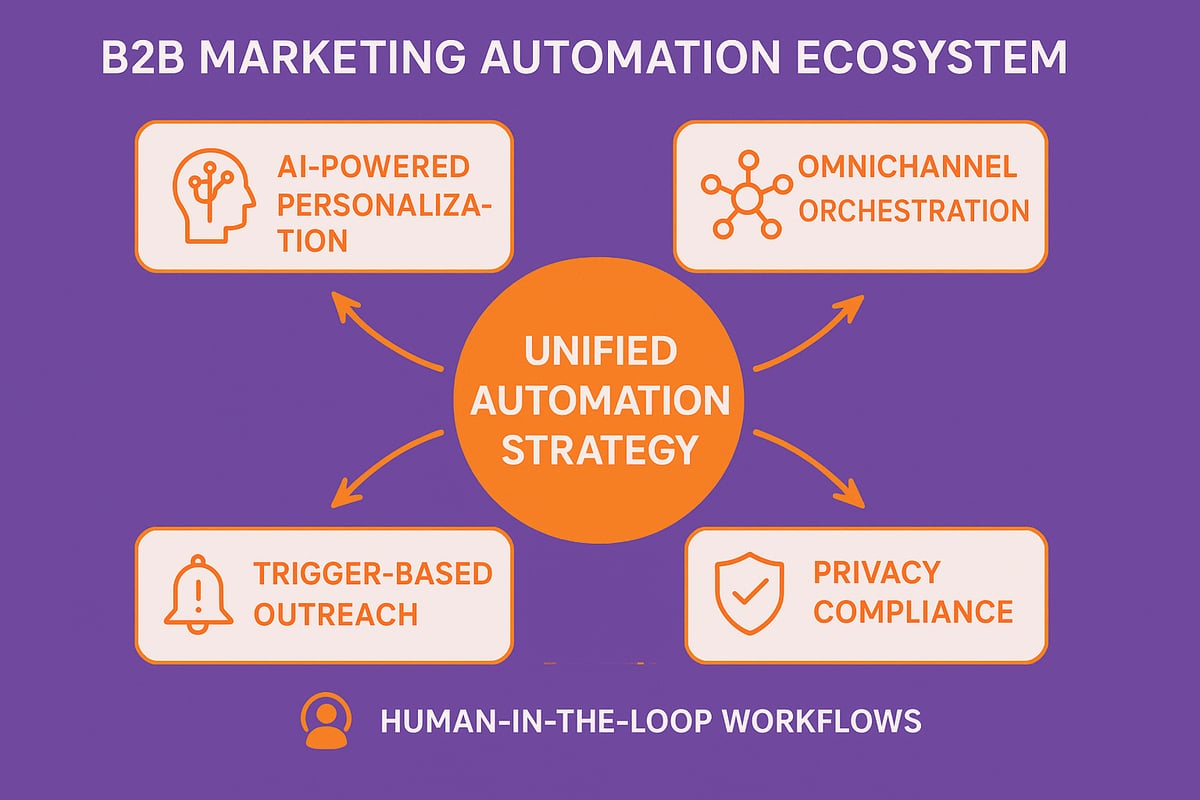
Assessing Your Current Tech Stack and Gaps
Start with a comprehensive audit of your existing b2b marketing automation stack. Map out every tool, integration, and workflow currently in use. Identify overlaps, inefficiencies, and missing capabilities.
Ask yourself: Are you leveraging AI for personalization? Is your outreach truly omnichannel or still siloed? Review your data sources, compliance processes, and how easily your platforms talk to each other.
A simple table can help:
| Area | Current Tools | Gaps/Opportunities |
|---|---|---|
| Personalization | [Tool Name] | Need AI-driven content |
| Orchestration | [Tool Name] | Lacks cross-channel |
| Compliance | [Tool Name] | Manual opt-in tracking |
This process uncovers where your b2b marketing automation can evolve to meet 2025 standards.
Building the Business Case for New Automation Investments
Next, quantify the value of upgrading your b2b marketing automation. Link automation initiatives directly to core metrics like pipeline velocity, engagement rates, and revenue growth.
Use industry benchmarks and ROI data to justify investments. For example, according to the B2B Marketing Digital Trends 2025 Report, AI-driven automation is expected to deliver measurable returns by the end of 2025.
Align your case with sales and marketing goals. Present scenarios showing how advanced analytics, predictive lead scoring, or omnichannel orchestration can improve outcomes. Secure buy-in by demonstrating how b2b marketing automation investments will future-proof your business.
Change Management and Team Enablement
Technology alone cannot drive b2b marketing automation success. Equip your teams with training and resources to master new platforms and workflows.
Establish clear processes for collaboration between marketing, sales, and IT. Foster a culture where human-in-the-loop automation is embraced, not feared.
Roll out new features in phases, gather feedback, and adapt training as needed. Encourage experimentation and reward early adopters who champion automation best practices across the organization.
Measuring Success and Iterating on Your Approach
Set clear KPIs for each new b2b marketing automation trend you implement. Track personalization impact, ABM pipeline growth, and engagement across channels in real time.
Build dashboards that surface actionable insights, not just vanity metrics. Run A/B tests, analyze results, and double down on what works.
Regularly revisit your strategy to ensure it evolves as your business and the b2b marketing automation landscape change. Continuous improvement is the key to staying ahead.
Key Technologies and Tools Powering 2025 B2B Marketing Automation
The technology stack for b2b marketing automation in 2025 is more sophisticated, interconnected, and AI-driven than ever. Modern marketers depend on a blend of established platforms and cutting-edge tools to streamline campaigns, ensure compliance, and drive measurable ROI.
Leading Platforms and Solutions
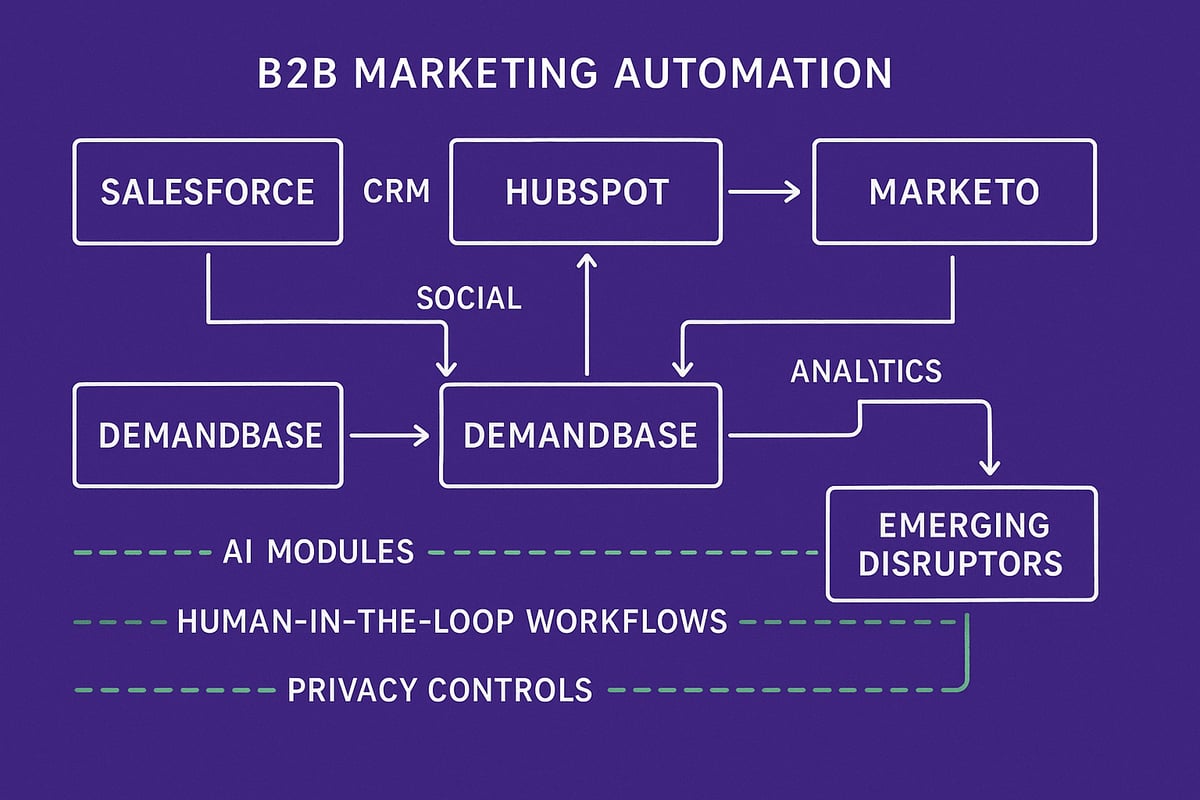
Today’s b2b marketing automation ecosystem is anchored by a handful of leaders, with innovation coming from both established names and agile disruptors. Salesforce, HubSpot, Marketo, and Demandbase all offer robust platforms, while newer entrants push the envelope on AI, ABM, and privacy.
| Platform | Core Strength | AI Capabilities | ABM Modules | Privacy Compliance |
|---|---|---|---|---|
| Salesforce | CRM Integration | Advanced | Yes | Strong |
| HubSpot | Usability, Onboarding | Evolving | Yes | Good |
| Marketo | Enterprise Automation | Mature | Yes | Strong |
| Demandbase | Account Insights | Strong | Advanced | Good |
Most organizations combine these platforms with specialized tools, creating a best-of-breed stack tailored to their unique needs. This approach empowers b2b marketing automation to deliver seamless, personalized, and scalable experiences.
Integrations and Ecosystem Considerations
Interoperability is the lifeblood of effective b2b marketing automation. Open APIs and native integrations are essential for connecting CRM, social, email, and analytics systems. For example, integrating LinkedIn, Slack, and trigger-based inbound automation enables real-time, holistic outreach across the buyer journey.
Key considerations when evaluating platforms include:
- Scalability for growing data and user bases
- Quality of support and vendor reliability
- Innovation roadmap and feature velocity
Connecting these systems breaks down data silos and enables marketers to orchestrate campaigns with precision. As privacy requirements increase, seamless integration also ensures that consent and compliance flow across every touchpoint. For more on how real-time triggers enhance outreach, see trigger-based inbound automation.
The Role of AI and Human Collaboration
AI is transforming b2b marketing automation, but human expertise remains indispensable. Platforms now offer AI-powered lead scoring, content recommendations, and predictive analytics, yet the most effective strategies still rely on human-in-the-loop workflows for quality control and personalization.
Tools like AI-driven sales assistants, message customization modules, and approval workflows make it possible to scale outreach without sacrificing relevance. AI augments marketer capabilities, uncovering insights and automating routine tasks, while humans maintain oversight and creative direction.
Looking ahead, the convergence of automation, AI, and human creativity is set to define the next era of b2b marketing automation. To dive deeper into how AI is reshaping sales and marketing processes, explore AI in sales automation.